
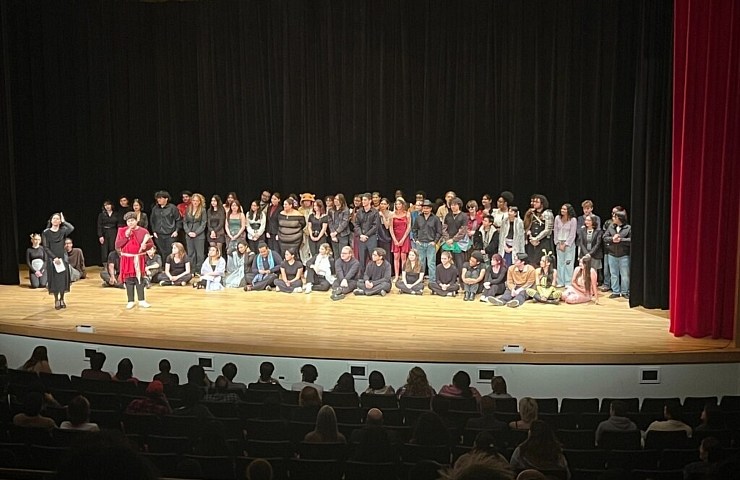
Cover Photo Courtesy Melisa Unlu
The Honors Club Theater at the University of Houston is not like most theater programs. It is entirely student-written, student-directed and student-run. With limited funding, a rotating roster of directors each semester and an ever-changing ensemble of beginners and veterans, the club has built a collaborative culture that blends mentorship with creativity.
This semester, several actors, directors and technicians shared their experiences navigating rehearsals, building worlds on stage and finding their place in the theater community.
The cast and crew for this semester’s showcase included Han Jamail Herrick, Wes Stivers and Ann Inciarte-Flores, as well as many more students including Lamont, Lucero and Lily, who prefer to go by first name only. Many of these students took on multiple roles.
Lamont, a graduating senior majoring in health with a concentration in public health and a minor in legal studies, joined the theater club only after attending the spring 2024 showcase. This semester, Lamont took on two roles, Raven in “Birds of a Feather” and the barista in “Demons and Divorce.”
According to Lamont, rehearsals for “Birds of a Feather” were once a week starting in September, but inconsistent attendance made line learning difficult.
“People didn’t really come to rehearsal, so I was not able to practice all my lines,” said Lamont. For “Demons and Divorce,” Lamont joined late in the semester, doubling his rehearsal load.
Like Lamont, Lucero joined “Demons and Divorce” late as well.
“We joined as people dropped,” Lucero said. “The lines were a time crunch, but we all got along really well.”
Stivers, who played Faust, one of the two demons in “Demons and Divorce,” used his background in psychology to help shape his character.
“A lot of my character choices came from imagining an insecure football player trying to cover it all up,” Stivers said. “It was a lot of actors coming up with stuff and testing it. If it didn’t work out, it got cut.”
The beginner-friendly nature of the club shapes the students’ approach on set and behind the scenes.
On director-actor dynamics, Lamont described the structured environment.
“‘In Birds of a Feather,’ it was very much like a boss/employee. The director had certain expectations … I remember one rehearsal where she said, ‘I want you to learn this and I will try to throw you off,’” Lamont said.
According to Lucero, it is all in good spirit.
“Theater and acting can be learned. If the actor has a growth mindset, we can all succeed,” said Lucero.
Showcasing exactly that kind of mindset in “My Flower,” Inciarte-Flores not only acted but also translated her lines.
“I added a lot of slang from my country and the way we specifically talk rather than what Google gave us,” Inciarte-Flores said.
This contribution added authenticity and cultural nuance to the script.
Just as passionate as both an actor and stage manager, Herrick sees these performances and the importance of rehearsals from multiple perspectives.
“Rehearsal is repetition … You learn everything by muscle memory so that on stage it doesn’t have to be a conscious choice,” he said about acting.
On the stage manager front, Herrick emphasizes the importance of early integration of the sets with the actors.
“If there is a physical set, you want to start rehearsing with that as soon as possible,” he said, adding, however, “Tech is its own separate show … We’re there to help the shows, to facilitate showcases and provide resources.”
Originally a tech and costume crew member, Lily, who only transitioned into acting because her high school needed performers, thrifted everything, including the costume.
“I will never wear a costume again,” she said, but later added “I will always have some sort of performance in my life as long as I am able.”
Members, directors, managers and everyone across the board emphasized the importance of communication in club theater.
While Herrick emphasized the rotating-director models as key to the club’s community feel, Lucero highlighted the need for understanding when actors struggle and Lily discussed how a director’s critique can hit on harder days. Lily also added that trust in directors usually softens the blow.
Despite the challenges, everyone placed importance on the club being a place where beginners can become performers, techies become leaders and students discover what theater can mean when it is with friends.




Recent Comments